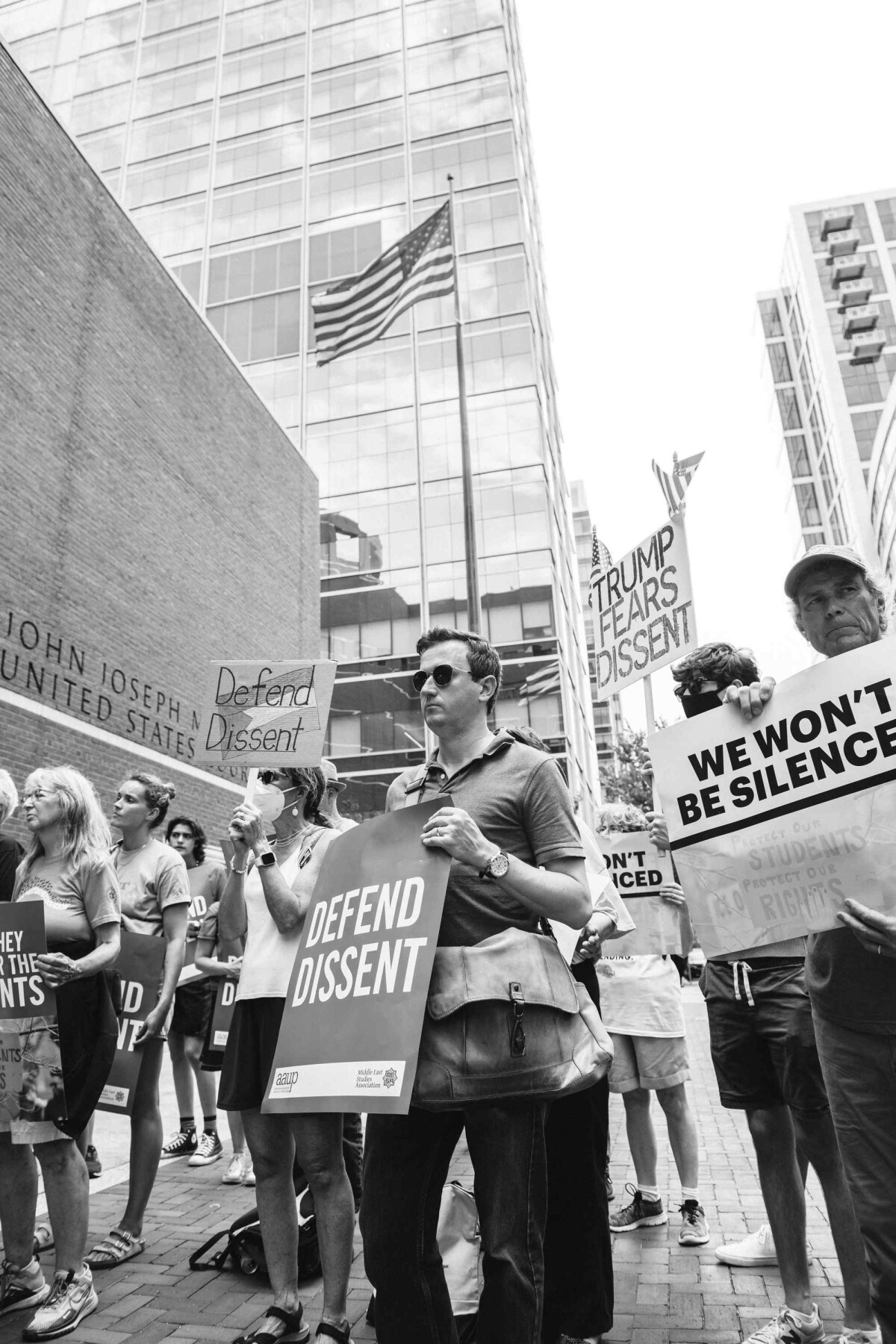
We knew a second Trump administration would test the limits of the First Amendment. Trump’s first term featured regular attacks on the freedoms of speech and the press. His campaign for a second was a blatant and repeated promise of escalation—a stark expression of intent to wield government power to punish political enemies and whole sectors of civil society. Since winning the election, he has kept that promise—bringing to bear the full resources of the executive branch, from federal law enforcement and every cabinet department to traditionally independent regulatory agencies, in attacking speech rights and press freedom.
What we didn’t foresee was that so many of our civic institutions would buckle. Congress abdicated crucial constitutional powers. Media organizations, many with ample litigation resources, settled lawsuits that would surely have failed on First Amendment grounds had they gone to trial. Leading law firms, targeted for representing individuals Trump views as enemies and for taking up causes the administration opposes, not only curtailed such representation but gifted the administration millions of dollars in pro bono services. Universities yielded to demands that their presidents resign or be removed, shared information with the government on internal inquiries and on their faculty and students, and moved to stifle protected political speech. And the list goes on.
It’s been the kind of year, in short, that relentlessly demanded that free expression and press freedom organizations do more, and do better—and as the year comes to a close, I could not be prouder of the work the Knight Institute has done.
As I write this, a Knight Institute legal team is preparing for a hearing on remedies in AAUP v. Rubio, a case that produced a dramatic two-week trial this summer and a blistering decision holding that the administration’s practice of detaining and deporting noncitizen students and professors for peaceful pro-Palestinian activism is unconstitutional. The Supreme Court just a few hours ago rejected a petition from the Trump administration to halt our challenge to a policy unconstitutionally restricting the speech of immigration judges. This follows a ruling from an appellate court compelling a district court judge to rule promptly on our petition to order the release of the Special Counsel’s report about Trump’s mishandling of classified information at Mar-a-Lago. We secured a string of other important victories throughout the year, in cases including Dada v. NSO Group, our lawsuit on behalf of journalists whose phones were hacked using NSO Group’s Pegasus spyware; A.B.O. Comix v. San Mateo County, a challenge to the digitization of mail in San Mateo County’s jails; Texas Tribune v. Caldwell County, ending the exclusion of the press and public from bail hearings in Texas; Northeast Organic Farming Association v. USDA, a challenge to the government’s deletion from its websites of information relating to climate change; and PETA v. Tabak, another in a line of Institute cases challenging government blocking of disfavored content on social media, finding (again) that such blocking is unconstitutional.
That’s just our litigation. We completed major Institute research projects and published a wealth of new scholarship focusing on Artificial Intelligence and Democratic Freedoms, The Future of Press Freedom, Federal Funding and the First Amendment, and The First Amendment and the Exchange of Ideas Across Borders. We also just launched Lawyering Without Law: The Legal Profession in an Age of Authoritarianism, an initiative that will explore the crucial role that lawyers play around the world in preserving democratic freedoms and institutions in times—well, in times such as these.
Beyond these projects, on our own and with colleague organizations, we continued to advance legislative and regulatory proposals to protect and strengthen the free speech ecosystem online. We also proudly stood with all who refused to capitulate to administration pressure. We produced a 13-episode podcast series, “The Bully’s Pulpit,” featuring some of the courageous people who stood firm against the Trump administration’s bullying. And when law firms, universities, media organizations, and other critical civil society institutions got weak-kneed, we gathered our colleague organizations to exhort those institutions to do better.
The Knight Institute is a small organization. We’re able to do what we do because we have a talented and committed staff, incredibly courageous clients, and generous and expert partners. This year we want especially to thank Selendy Gay, Hueston Hennigan, Simpson Thacher, and Sher Tremonte for the time, energy, knowledge, and resources they directed to our joint projects. Enormous thanks, too, to our funders, whose support we’ve especially appreciated over this challenging year.
And thanks, finally, to all of you. All of us at the Knight Institute are deeply grateful for this community of scholars, students, journalists, engineers, policy wonks, litigators, advocates, and so many others who share our commitment to First Amendment freedoms and to the values they reflect.
Jameel Jaffer is executive director of the Knight Institute.